I learned the hard way that measuring curtain length for sliding glass doors isn’t just about grabbing a tape measure and hoping for the best. After hanging panels that pooled awkwardly over my threshold and snagged every time I grabbed a snack from the patio, I now pay careful attention to rod height, float clearance, and stack-back space.
Start by mounting your rod 4–6 inches above the door frame (or 8 inches if you’ve got soaring ceilings), then measure straight down to the floor and subtract ½ to 1 inch for that perfect float. This prevents the hem from dragging on the floor.
Standard lengths like 84, 96, or 108 inches work for most setups, but don’t forget to account for molding depth and raised thresholds that can throw off your math.
Double your door width for lush, hotel-worthy fullness, then divide by your panel size to figure out if you need two panels or three.
If your sliding door is some weird custom size that doesn’t match standard measurements, custom curtains are your best option. This eliminates hovering hems or tripping hazards.
Find the Right Rod Height Above Your Sliding Door
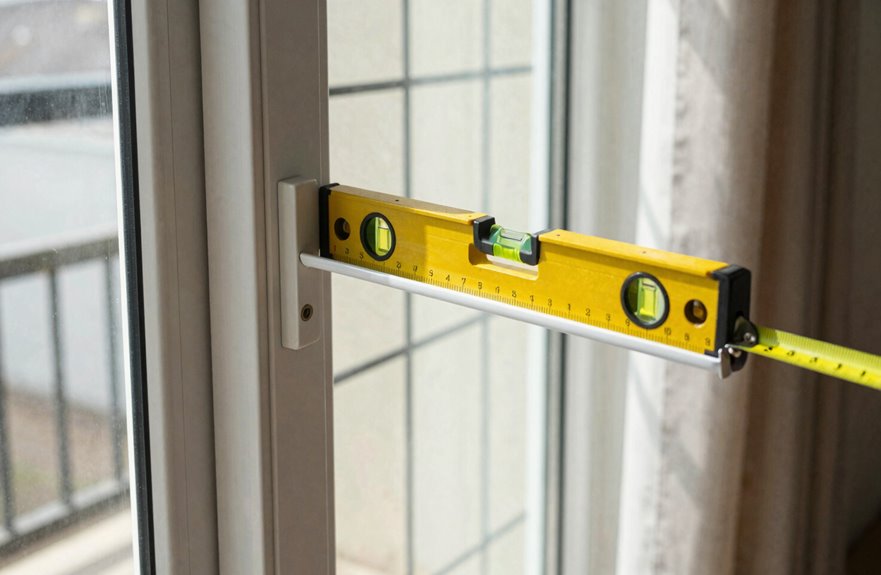
Where do I even start when I’m staring at my sliding door, tape measure in hand, feeling slightly overwhelmed? I’ve been there, and I’m here to walk you through it.
For sliding glass doors, I always go outside-mount because it gives that gorgeous, expansive look. Here’s my trick: I measure height starting from the top of the door frame, then I add 4–6 inches for my rod height. Want drama? Push it higher. I’ve mounted rods 8 inches above the door frame in rooms with tall ceilings, and the difference is noticeable.
That extra lift creates door frame clearance so panels glide smoothly. It also makes ceilings appear taller. Nailing this step makes every curtain length decision easier down the road.
Measure Curtain Length From Rod to Floor (or Just Above)
Measure Curtain Length From Rod to Floor (or Just Above)
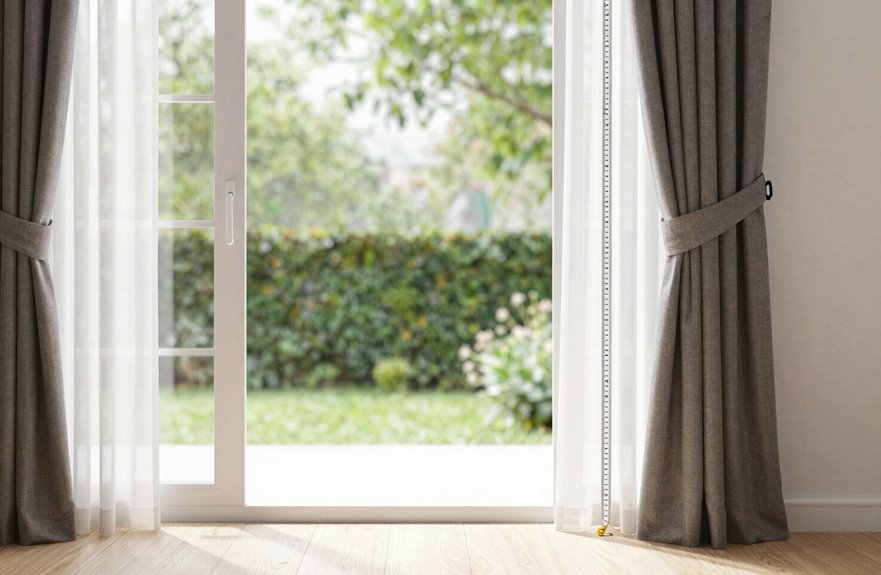
Now that I’ve got my rod mounted high and proud, it’s time to figure out exactly how long these curtains need to be. I’m grabbing my tape measure to determine the correct length from curtain rod to floor.
Here’s my process for getting accurate measurements:
- I measure straight down from the rod placement to the floor without diagonals or guessing.
- I subtract ½ to 1 inch for floor clearance, so my hem floats just above floor level.
- I check standard lengths; 84 or 96 inches fits most sliding glass doors, while 108 inches provides extra visual drama.
- I remember that rod placement at 4 inches above the frame means I’m adding that to my final number.
That tiny gap makes sweeping and cleaning much easier.
Adjust for Door Frames, Molding, and Floor Thresholds
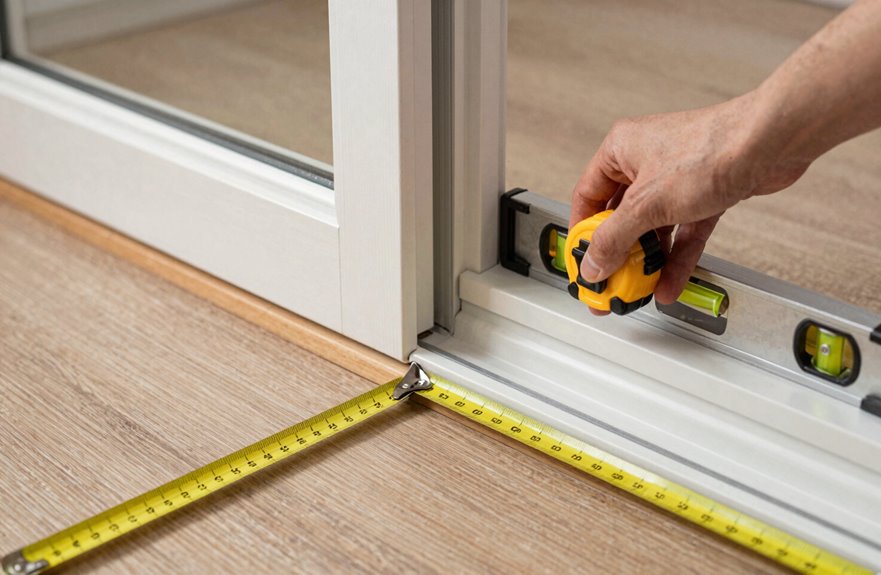
Door frame clearance is critical for proper curtain operation. When measuring for floor threshold gaps, check where the metal strip rises, as fabric catching on raised edges will create creases and wrinkles that require repeated smoothing.
You have two main options: full puddle style, which is luxurious but requires regular maintenance, or a half-inch float above the threshold for a crisp appearance. Both approaches produce professional results when executed deliberately and maintained consistently.
Door Frame Clearance
How do you keep curtains from turning into a tangled mess every time someone slides that door open? Door frame clearance isn’t negotiable; it’s everything.
Here’s my battle-tested approach:
- Rod height goes 4–6 inches above the frame, giving your curtains breathing room above any molding.
- Outside mounting extends 6–12 inches past each side, so panels stack clear of the glass entirely.
- Curtain length accounts for that raised rod. Measure from top to where you want fabric to land.
- Floor clearance stays at ½–1 inch, because nobody wants dusty hems dragging through thresholds.
I once ignored molding depth, and my panels snagged constantly. When you respect these clearances, your sliding door glides smoothly, your curtains hang without obstruction, and your space functions as intended.
Floor Threshold Gaps
Nothing kills a curtain’s vibe faster than watching it snag, drag, or collect every crumb from a raised threshold like some kind of fabric Roomba.
When measuring sliding glass doors, always check for thresholds first. The rod-to-floor measurement is just the starting line. Subtract any molding or weatherstripping height, then aim for sweet hem clearance of about ½ inch to 1 inch above the floor threshold. Raised thresholds need panels skimming ¼ inch to ½ inch higher, max. When thresholds vary between rooms, use the longest drop and adjust panels for consistent coverage.
| Threshold Type | Rod-to-Floor Adjustment | Ideal Floor Threshold Clearance |
|---|---|---|
| Flat track | Subtract ½ inch | ½ inch hem clearance |
| Raised metal strip | Subtract ¾ inch | ¼ inch above threshold |
| Weatherstripping bump | Subtract full molding height | 1 inch for smooth glide |
| Uneven room transitions | Use longest measurement | Trim panels to match |
Use “Float” Length to Keep Your Sliding Door Functional
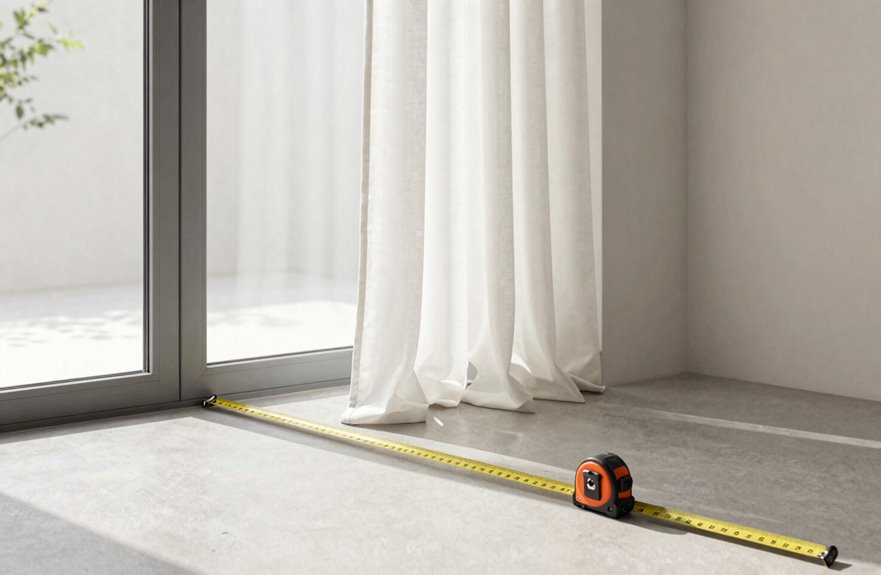
I’m a fan of the “float” look, keeping your curtain hem about ½ to 1 inch above the floor so the fabric skims without snagging on the track. I learned this the hard way after my first panels got jammed every time I tried to let the dog out. Now I measure from the rod down to that sweet spot where the hem hovers just so, like a magic trick. It’s practical and attractive. You’ll notice the difference every time you glide that door open.
Float Length Definition
Why do I keep tripping over my own curtains every time I grab a snack from the patio? Curtain length for sliding glass doors matters more than expected. Float length solved this problem: that sweet spot about 1/2 inch to 1 inch above the floor keeps the hemline clear of the track.
What works:
- Measure from rod height down, aiming for that 1/2 inch clearance. This prevents snagged fabric.
- Adjust ready-made drops (84″, 96″, 108″) by raising the rod slightly to hit float length perfectly.
- Watch the curtain glide smoothly without bunching in the track when moving outside quickly.
- The neat hemline protects the fabric from floor wear and extends its lifespan.
Float length keeps the slider functional and prevents the damage caused by curtains dragging on the floor or getting caught in the track.
Measuring Float Height
Float length sounds simple until you’re standing there with a tape measure, wondering if that half-inch gap will affect your sliding glass doors. That tiny floor clearance makes all the difference.
I measure length from my rod height down, aiming for that sweet ½ to 1 inch curtain drop above the floor. Too long? Your hem snags the track, and suddenly you’re fighting your curtain like it’s got a personal vendetta. I’ve learned this the hard way.
My guide for nailing float height:
| Ready-Made Drop | Standard Rod Height | Resulting Float |
|---|---|---|
| 84 inches | 84-85 inches | Perfect float |
| 96 inches | 96-97 inches | Ideal clearance |
| 108 inches | 108-109 inches | Gorgeous hover |
| Custom length | Measure carefully | Your call |
| Too long | Adjust up | Crisis averted |
Getting your curtain length right ensures doors that glide smoothly without catching or dragging.
Daily Use Benefits
A half-inch of air between my hem and the floor has saved my sanity more times than I can count. When you’re rushing out with coffee in hand, that tiny gap matters.
Float length wins for daily use benefits:
- No more track snags. My curtain length glides past the door track clearance smoothly, with no catching or damage.
- Zero threshold tripping. Proper floor clearance means my sliding glass door moves smoothly every single time.
- Fabric stays pretty. That hem position above the sill stops fraying, so my panels look fresh rather than frazzled.
- Smart rod hacks work. I adjust ready-made drops by mounting higher to achieve instant float length.
I measure rod-to-floor, set my hem, and the result is both functional and attractive. Your future self, rushing to the patio with wine, will appreciate the smooth operation and maintained appearance of your curtains.
Check If Standard 84, 96, or 108 Inch Lengths Will Fit
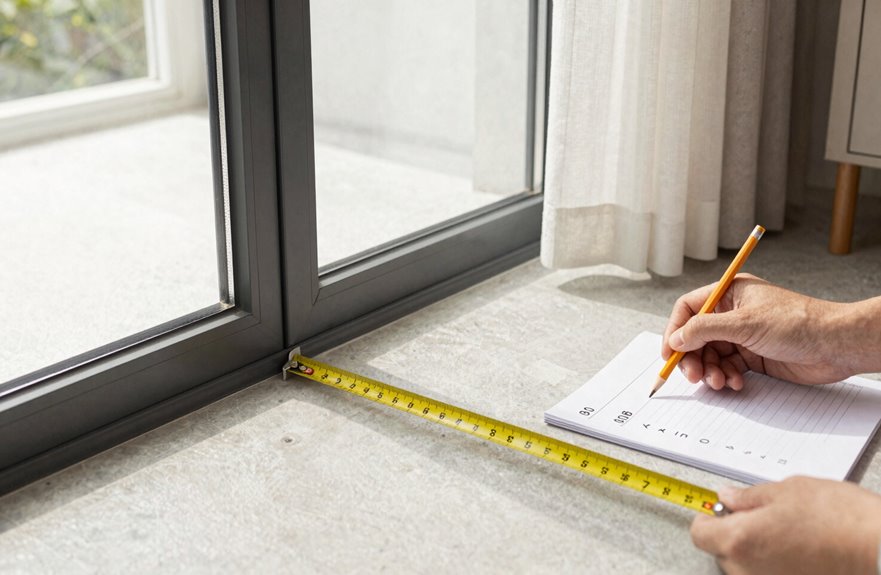
How do you begin when you’re staring at that wall of glass, tape measure in hand, wondering if those pretty panels online will actually work? I’ve been there, sweating over whether my curtain length would make or break my sliding glass door plans.
Standard lengths of 84 inches, 96 inches, and 108 inches usually eliminate the need for custom orders. Most sliders sit around 80 inches tall, so mounting the rod just above the frame means 84 inches or 96 inches often fits perfectly. A little floor clearance of about half an inch prevents panels from catching and keeps hems clean without tripping hazards when carrying items outside.
For tall ceilings, 108 inches allows for dramatic pooling at the floor. Measure twice before ordering. Eyeballing measurements can result in panels that fall at awkward heights. If your measurements fall between these standard lengths, custom curtains provide a perfect fit without compromise.
Measure Total Width and Stack-Back for Full Coverage
Once I’ve got my length figured out, I turn my attention to width. This is where I once messed up so badly I ended up with curtains that looked like sad, flat bedsheets hanging by my slider.
I once messed up so badly I ended up with curtains that looked like sad, flat bedsheets hanging by my slider.
To nail that gorgeous, full coverage:
- I measure width across my sliding glass door first, then add 10–15 inches per side for stack-back, which is the space where panels cozy up against the wall when open.
- I double my rod width for total panel width, so an 80-inch rod means roughly 160 inches of fabric total for that lush fullness.
- I maximize stack-back on wide sliders, ensuring panels fully clear the glass and rest flat against walls.
- Curtain length matters less here, but getting this width calculation right is critical.
Calculate How Many Panels You Need for Smooth Opening
So how do I figure out the magic number of panels without turning my slider into a tangled mess? It’s all about the math, but it’s simple multiplication, not calculus.
First, grab your door width, then multiply by your chosen fullness factor: 1 for breezy and relaxed, 2 to 3 for that lush, magazine-worthy pleating. That gives you your total panel width. Then divide by your preferred panel width, and you’ve got your number of panels.
For a standard slider, you’ll typically need 2 to 3 panels, creating gorgeous volume while keeping that stack-back neat on both sides. Curtain width matters, but so does functionality. Panels that fight you every morning defeat the purpose of having them.
Order Custom Curtains for Non-Standard Sliding Door Sizes
Why settle for curtains that hover awkwardly above your floor or stop three inches short of your rod? I’ve been there, friends, and it’s the decorating equivalent of wearing high-water pants to a dinner party. When you’ve got non-standard door sizes, custom curtains become your salvation, not just a luxury.
Here’s how I navigate this beautifully chaotic process:
- I measure length obsessively, twice, thrice, because my “eyeballing it” phase ended in tragedy.
- I add 6–12 inches past my sliding glass door width for that outside-mounted rod to actually block light, not just frame it pathetically.
- I specify rod width and drop precisely, since made-to-measure beats those sad, standard 84-inch panels every single time.
- I choose puddle length for drama, or floor length for sanity. Your track clearance will affect how the curtains hang and function.
Many retailers offer free measurement services, and I absolutely use them. This eliminates guesswork and reduces the risk of ordering incorrect dimensions.